REMARKS ON
THE LODE AT WHEAL MARY ANN.
MENHENIOT.
By C. Le Neve Foster, B.A., D.Sc., F.G.S.
30th October, 1874.
Some weeks ago I was underground at Wheal Mary Ann, and I
there observed certain peculiarities in the lode which, I think, are worthy of
being recorded, especially as the mine is on the point of being abandoned, and further
observation will be impossible --- at all events, for some years. It is true that the peculiarities of Wheal Mary Ann have not escaped the
observant eye of Mr. Henwood, who has described the lode in the Transactions
of the society, and also in the Journal of the Royal Institution of Cornwall. Mr Giles has also written upon the same subject in our Transactions, and
so has Mr. Salmon in the Mining and Smelting Magazine. However, in no published
account have I been able to find any cross-section showing the structure of the
lode, and as I can supply this omission, I have no hesitation in going over what may appear to some persons an old story.
The lode runs a few degrees east of true north, and dips east at an angle of 60
to 80 . The flatter parts of the lode are generally poor, and filled with fragments of killas, or clay-slate, which constitutes the
surrounding rock or " country ."
I need not dwell, however, on this point,
as it is a common occurrence, and can easily be explained mechanically. I proceed at once to the
main subject of my paper, in which I shall first describe the appearances shown
underground at Wheal Mary Ann, and then point out what are the conclusions that
may be drawn as to the formation of the lode. I greatly regret that I could only
make
observations over a very small extent of the lode. I simply saw one end at the
250 fathoms level, and one set of stopes, the only workings going on; but the
facts
observed were so clear, that I feel almost sure that my opinions would be
confirmed, rather than shaken, by additional evidence.
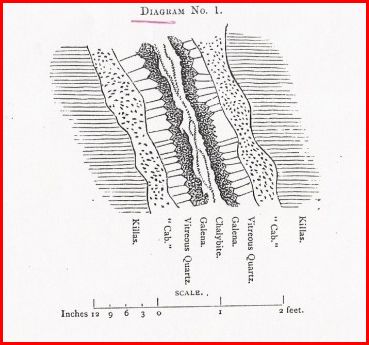
Diagram 1
Diagram No 1 shows a characteristic section of the lode as seen in the 250 fathom level. We have, first of all. the two walls of killas; then, proceeding inwards from each wall, the cab, a sort of chalcedony; next, ordinary vitreous crystallized quartz; next galena; and finally chalybite, or spathose iron. The cab varies from 2 inches to 3 feet wide, and the lode proper is from 0 to 3 feet wide. If this were the only section seen, we might conclude that an open fissure had simply been gradually filled up by the successive deposition of the various minerals which we now find there; but the examination of other sections shows that, through simple, the process of filling up experienced breaks and interruptions.
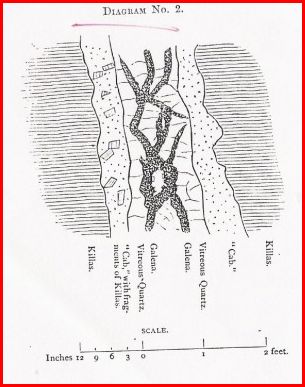
Diagram 2
Another diagram No 2 shows a section somewhat like No 1, save that the cab on the footwall contains angular fragments of killas.
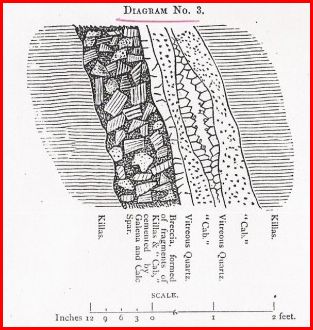
Diagram 3
Diagram No 3, taken from the lode close to No 1, is very
different in appearance. On the eastern or hanging wall, we have the cab
traversed by a vein of vitreous
quartz, which crystallizes out in a vugh; then a band of vitreous quartz;
and finally, on the footwall, a complete breccia of fragments of killas
and cab, cemented together by galena and calc spar.
From the examination of these sections, I deduce the following history of the
formation of the Wheal Mary lode.
Firstly, formation of a fissure, probably accompanied by a shifting of the
strata. A succession of open spaces were left, and some parts were more or less
filled up
by fragments that fell from the walls. Secondly, deposition of the cab, which more or less filled up the fissure
and cemented any fragments of the walls into a breccia. As would naturally be
supposed, this breccia occurs chiefly on the footwall. Thirdly, re-opening of the fissure. The new line of fracture sometimes went in
the middle of the filling up of cab, sometimes cut across it, and then
followed one of the
walls of the original fissure; pieces of the walls, and of the previously-formed
cab lode fell in, and then quartz, galena, chalybite, and calc spar were
deposited
successively in the open spaces.
The history of the formation of the Wheal Mary Ann lode is therefore not devoid
of interest. Had I been able to see more sections, I have no doubt other
peculiarities might have been
observed, though I expect they would have been essentially similar to those I
have described.
I can supplement this account of the Mary Ann lode by pointing out the order of
deposition of some of the minerals that is shown by specimens given to me at the
time.
A large specimen shows:
1. Fluor spar. 5. Chalybite.
2. Quartz. 6. Fluor spar.
3. Galena. 7. Iron Pyrites.
Another specimen gives the following series:
1. Fluor spar. 4. Quartz.
3. Fluor spar.
Another:
1. Fluor spar 2. Quartz.
3. Calc spar.
A fourth gives us the series:
1. Fluor spar 3. Galena.
2. Chalcedony. 4. Fluor spar.
There have, therefore, been at least two periods of formation of fluor spar; the
lead ore was deposited at an intermediate period, and the last minerals have
been quartz,
chalybite, and calc spar.
I have given these instances of the successive deposition of various minerals,
as this subject is too frequently passed over. It is, however, of
importance in the study of lodes,
because it enables us to compare lodes, not only when situated in different
parts of the same district, but also when situated in different countries. For
instance. what can be
more striking than the fact that the one definite order of deposition of the
minerals in the tin lodes of Saxony should hold good, in many cases, in the tin
lodes of Cornwall?
In conclusion, let me add that this branch of geological investigations has been
too much neglected in England, and that there is, consequently, a wide field of labour for the
geologists and mineralogists of this country.
30th October, 1874.